campaign
creatives

Top 8 What Is Marketing Attribution Modeling Platforms To Track Every Touchpoint
Discover the leading what is marketing attribution modeling platforms that help businesses accurately track and assign credit to every customer touchpoint driving conversions.
A customer sees your Instagram ad, clicks through to read a blog post, receives your email newsletter, searches your brand name on Google, and finally converts through a retargeting ad. Which channel gets credit for that sale?
If you're using last-click attribution, only that final retargeting ad shows up as valuable—while the Instagram ad that started the journey gets zero recognition. This attribution blindness costs businesses millions in misallocated ad spend every year.
Marketing attribution modeling solves this problem by tracking the entire customer journey and assigning appropriate credit to each touchpoint. The right tools can show you exactly which channels drive awareness, which nurture consideration, and which capture conversions—transforming marketing from guesswork into data-driven decision making.
The challenge? Choosing the right attribution platform. Some tools excel at multi-touch attribution across paid channels, while others specialize in connecting offline conversions to online touchpoints. Pick the wrong one and you'll either overpay for features you don't need or struggle with gaps in your tracking.
Here are the leading marketing attribution modeling tools that help businesses track every touchpoint driving conversions.
1. Google Analytics 4
Best for: Businesses seeking free, AI-powered attribution across Google's ecosystem with advanced machine learning capabilities.
Google Analytics 4 represents Google's fundamental reimagining of web analytics, moving beyond simple last-click attribution to machine learning-powered models that analyze your actual conversion patterns.
Where This Tool Shines
GA4's data-driven attribution model uses machine learning to examine all touchpoints in your conversion paths and assign credit based on each interaction's actual contribution. Unlike rigid rule-based models that follow predetermined formulas regardless of your business reality, GA4's algorithm learns from your specific data patterns—understanding which channel combinations and sequences actually drive conversions for your audience.
For businesses invested in Google's advertising ecosystem (Google Ads, YouTube, Display Network), GA4 delivers seamless integration that connects ad exposure to website behavior and final conversions without additional tracking complexity. The platform automatically accounts for cross-device journeys, using Google Signals to recognize when the same person interacts with your brand on mobile, then converts on desktop.
Key Features & Capabilities
Data-Driven Attribution Model: Machine learning adapts to your conversion patterns rather than forcing generic attribution rules.
Cross-Device Tracking: Google Signals connects user behavior across devices for logged-in users.
Google Ads Integration: Automatic bid optimization based on attribution insights without manual data transfers.
Conversion Path Reports: Visual journey maps showing touchpoint sequences and timing.
Model Comparison Tools: Side-by-side evaluation of how different attribution approaches credit the same conversions.
Predictive Metrics: Machine learning forecasts which users are likely to convert or churn.
Implementation Realities
GA4 requires proper technical setup to deliver accurate attribution. You'll need JavaScript tracking implemented across all pages, enhanced measurement configured for automatic event tracking, and conversion events properly defined to distinguish between micro-conversions (newsletter signups) and macro-conversions (purchases).
The data-driven attribution model needs sufficient volume to work effectively—typically 400+ conversions monthly. Below this threshold, you'll rely on rule-based models like linear or time decay attribution. The machine learning algorithm also requires a 2-4 week learning period before generating reliable insights.
Privacy restrictions impact accuracy. iOS App Tracking Transparency and cookie deprecation reduce cross-device tracking capabilities over time. Google Signals only works for logged-in users who've enabled ad personalization, covering a subset of your total audience.
Best For / Ideal Users
GA4 works best for businesses running significant advertising through Google's platforms who need sophisticated attribution without additional software costs. E-commerce sites benefit from connecting ad spend to transaction revenue. Content publishers use GA4 to understand which content types drive subscription conversions. SaaS companies leverage it for tracking product trial signups and conversions.
Teams with technical resources to handle implementation complexity extract the most value. You'll need someone comfortable with JavaScript, event configuration, and data analysis to set up and maintain accurate tracking.
Pricing
Completely free for standard use with generous data limits that accommodate most small to mid-size businesses. Google Analytics 360 serves enterprise needs starting around $50,000 annually, providing higher data limits, SLA guarantees, and dedicated support.
2. HubSpot Marketing Hub
Best for: B2B companies needing attribution integrated with CRM data to track long sales cycles from first touch to closed deal.
HubSpot Marketing Hub connects marketing activities directly to revenue outcomes by integrating attribution modeling with its CRM platform, eliminating the data silos that plague most attribution efforts.
Where This Tool Shines
HubSpot solves the B2B attribution puzzle where sales cycles span months and involve multiple decision-makers. The platform tracks every interaction—from anonymous website visits to known contact engagement to closed deals—and attributes revenue to specific marketing assets and campaigns.
Because attribution lives inside the same system as your contact database and sales pipeline, you can see exactly which blog posts, emails, or ads influenced specific deals. When a prospect downloads three whitepapers, attends a webinar, receives five nurture emails, and finally converts after a retargeting ad, HubSpot shows the complete journey and assigns appropriate credit to each touchpoint based on your chosen attribution model.
Key Features & Capabilities
Multiple attribution models: Choose from first touch, last touch, linear, time decay, W-shaped, or full path depending on what you need to prove.
Revenue attribution: Connects marketing spend directly to closed deals with actual dollar amounts, not just lead counts.
Contact-level attribution: Shows every touchpoint for individual customers, revealing what content actually influences purchases.
Campaign attribution: Aggregates results across email, social, ads, content, and events to show total campaign contribution.
Custom attribution reports: Filter by deal stage, contact properties, campaign type, or any CRM field to answer specific questions.
Attribution comparison tools: View the same data through different attribution lenses simultaneously to understand model impact.
Best For / Ideal Users
HubSpot's attribution works best for B2B companies with deal values that justify the platform cost and sales cycles long enough to benefit from multi-touch tracking. Marketing teams of 5-50 people who manage content marketing, email campaigns, and paid advertising will find the most value.
It's particularly powerful when sales and marketing teams share the same system—the attribution only works if sales consistently updates deal stages and closes opportunities in HubSpot CRM. Professional services firms, B2B SaaS companies, and manufacturing businesses with complex buyer journeys see the strongest ROI.
Pricing
Marketing Hub Professional starts at $800/month (billed annually) and includes attribution reporting. Enterprise tier at $3,600/month adds advanced attribution features and custom reporting capabilities.
3. Ruler Analytics
Best for: Businesses tracking phone calls and offline conversions alongside digital touchpoints for complete attribution visibility.
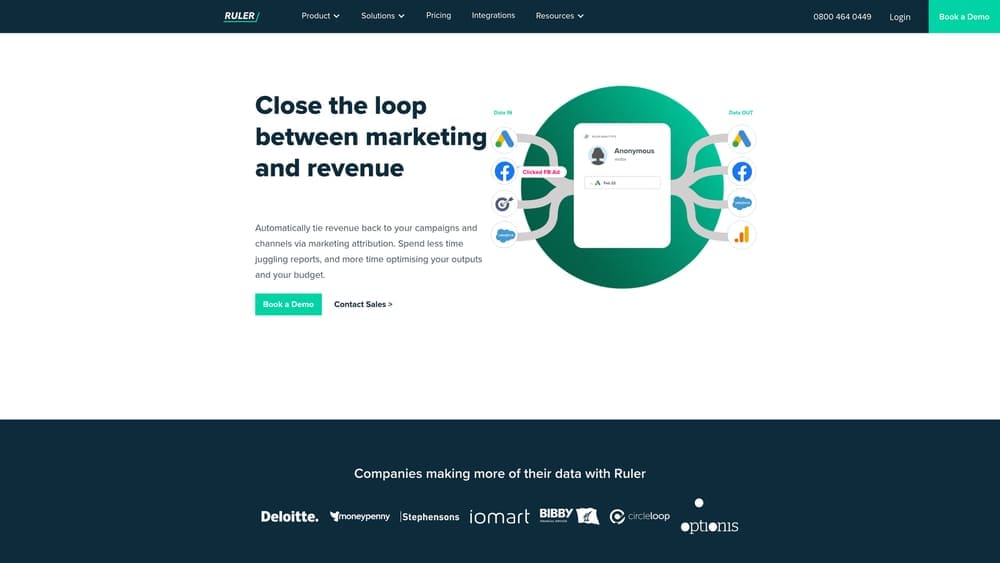
Ruler Analytics specializes in closing the loop between marketing and revenue by connecting online marketing activities to offline conversions, particularly phone calls and in-person sales.
Where This Tool Shines
Most attribution platforms focus exclusively on digital conversions—form submissions, online purchases, email signups. This creates massive blind spots for businesses where phone calls drive the majority of revenue. A law firm might generate 80% of new clients through phone consultations. A home services company books most jobs via call. A healthcare practice schedules appointments by phone. For these businesses, standard attribution tools miss the most important conversion action entirely.
Ruler Analytics solves this through dynamic number insertion technology that assigns unique phone numbers based on how visitors arrived at your site. When someone clicks your Google Ad and calls, Ruler tracks that call back to the specific campaign, ad group, and keyword. The platform then connects that call to your CRM, allowing you to see which marketing touchpoints generated not just calls, but actual revenue. This closed-loop tracking reveals the true ROI of upper-funnel activities that generate awareness and drive phone inquiries.
Key Features & Capabilities
Call Tracking with Dynamic Number Insertion: Automatically displays unique phone numbers based on traffic source, enabling precise attribution of inbound calls to specific marketing channels.
Form and Live Chat Attribution: Tracks form submissions and chat conversations across multiple websites, connecting these conversions to their originating marketing touchpoints.
Closed-Loop Revenue Tracking: Integrates with CRM systems to follow leads from first touch through final sale, attributing actual revenue to marketing activities.
Multi-Touch Attribution Models: Offers first-click, last-click, linear, time decay, and Markov chain models to analyze customer journeys from different perspectives.
Marketing Mix Modeling: Provides budget optimization recommendations based on which channels drive the highest-quality leads and revenue outcomes.
Best For / Ideal Users
Ruler Analytics serves businesses where phone calls represent a primary conversion mechanism—legal services, home services, healthcare providers, automotive dealerships, insurance agencies, and B2B companies with consultative sales processes. Marketing teams managing $10,000+ monthly ad spend across multiple channels who need to prove ROI beyond digital form submissions will extract the most value.
The platform is particularly powerful when sales teams close deals offline but marketing needs attribution data to justify budget allocation. If you're currently blind to which campaigns generate your most valuable phone leads, Ruler provides the visibility that standard analytics tools cannot.
Pricing
Plans start around $199/month for basic call tracking and attribution capabilities. Full marketing attribution features with advanced modeling and integrations are available in higher tiers starting around $499/month. Enterprise pricing is available for businesses with large call volumes and complex attribution needs.
4. Segment
Best for: Technical teams building custom attribution models with complete control over data collection and routing.
Segment functions as a customer data platform that collects, cleans, and routes behavioral data to analytics and attribution tools, providing the infrastructure for sophisticated attribution modeling.
Where This Tool Shines
Segment doesn't provide attribution models out of the box—instead, it solves the data collection and integration challenges that make attribution difficult. The platform captures every customer interaction across web, mobile, server, and cloud apps using a single API, then routes that data to your attribution tools, data warehouse, or custom analytics systems.
This approach gives technical teams complete flexibility to build attribution models tailored to their specific business logic rather than conforming to predefined models. For companies with unique customer journeys or complex product ecosystems, Segment provides the data foundation that makes accurate attribution possible. The platform's identity resolution capabilities connect anonymous browsing behavior to known user profiles, ensuring attribution models can track the complete journey from first visit to conversion.
Key Features & Capabilities
Single API Implementation: Track events across all platforms and devices with one consistent tracking code.
300+ Pre-Built Integrations: Connect to analytics, attribution, and marketing tools without custom development.
Real-Time Data Streaming: Route data to multiple destinations simultaneously as events occur.
Data Governance Controls: Ensure consistent tracking implementation with validation rules and schemas.
Identity Resolution: Connect anonymous and known user behavior across devices and sessions.
Data Warehouse Integration: Send clean, structured data to Snowflake, BigQuery, or Redshift for custom attribution modeling.
Privacy Controls: Manage consent and data collection compliance across all tracking.
Best For / Ideal Users
Segment serves technical teams at growth-stage startups and enterprises that need attribution flexibility beyond what packaged tools provide. Companies with engineering resources to build custom attribution logic will extract the most value.
It's particularly powerful for businesses with multiple products or apps requiring unified tracking, or those with specific compliance requirements that demand granular control over data collection and routing. Teams combining Segment with data warehouses like Snowflake or BigQuery can build sophisticated custom attribution models that reflect their unique business logic.
Pricing
Free tier available for up to 1,000 monthly tracked users. Team plans start around $120/month for basic features. Business tier pricing varies based on data volume but typically starts around $1,000/month for meaningful usage. Enterprise pricing available for large-scale implementations with advanced governance needs.
5. Attribution
Best for: E-commerce brands running multi-channel paid advertising who need real-time attribution to optimize daily ad spend.
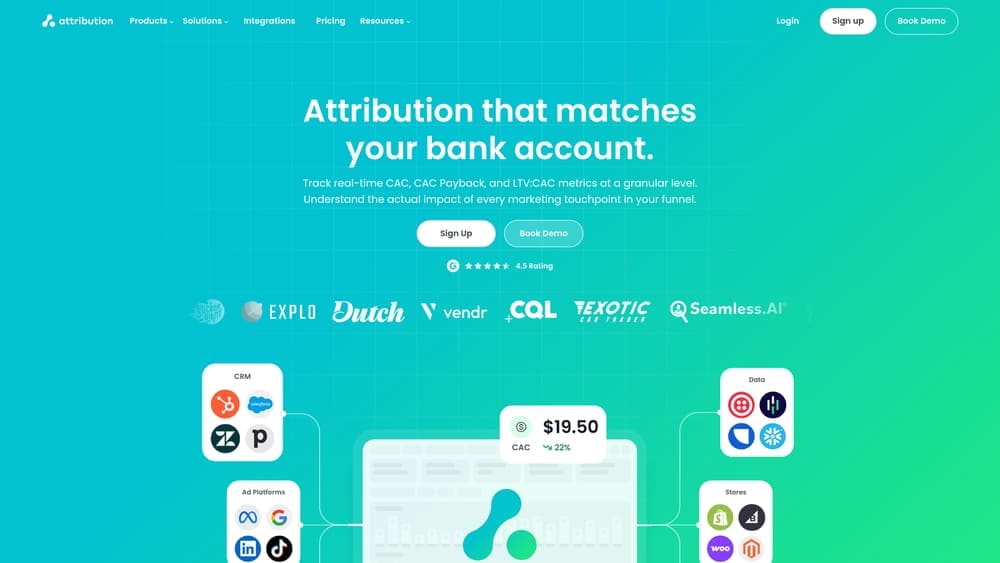
Attribution provides real-time marketing mix modeling specifically designed for e-commerce brands managing complex paid advertising across multiple platforms.
Where This Tool Shines
Attribution uses incrementality testing and marketing mix modeling to show which channels actually drive incremental sales rather than just capturing existing demand. The platform runs continuous experiments to measure true lift from each marketing channel, accounting for factors like seasonality, promotions, and external market conditions.
This approach reveals when you're overspending on bottom-funnel channels that capture demand created by upper-funnel activities. For e-commerce brands spending $50,000+ monthly on paid advertising, Attribution's daily optimization recommendations can quickly pay for the platform cost through improved efficiency.
Key Features & Capabilities
Real-time incrementality measurement: Shows true channel contribution beyond last-click attribution.
Marketing mix modeling: Accounts for external factors and seasonality in attribution analysis.
Daily budget optimization: Provides actionable recommendations across channels based on performance data.
Major ad platform integration: Connects with Meta, Google, TikTok, Pinterest, and Snapchat for unified tracking.
Forecasting tools: Predicts revenue impact of budget changes before you commit spend.
Creative-level attribution: Shows which ad variations drive results, not just which channels.
Cohort analysis: Tracks long-term customer value by acquisition channel for LTV optimization.
Best For / Ideal Users
Attribution serves e-commerce brands with significant paid advertising budgets who need to optimize daily spending decisions. Direct-to-consumer brands, online retailers, and subscription businesses spending $50,000+ monthly across multiple paid channels will see the fastest ROI.
Marketing teams managing complex campaigns across 4+ advertising platforms benefit most from the unified view and optimization recommendations. The platform is particularly valuable for brands where small efficiency improvements translate to substantial revenue gains.
Pricing
Pricing is customized based on monthly ad spend and typically starts around $2,000/month for brands spending $100,000+ monthly on advertising. The platform generally targets mid-market to enterprise e-commerce businesses where the optimization value justifies the investment. Free trial and demo available to evaluate fit.
6. Rockerbox
Best for: Consumer brands needing attribution across digital advertising, retail media networks, and offline channels like TV and direct mail.
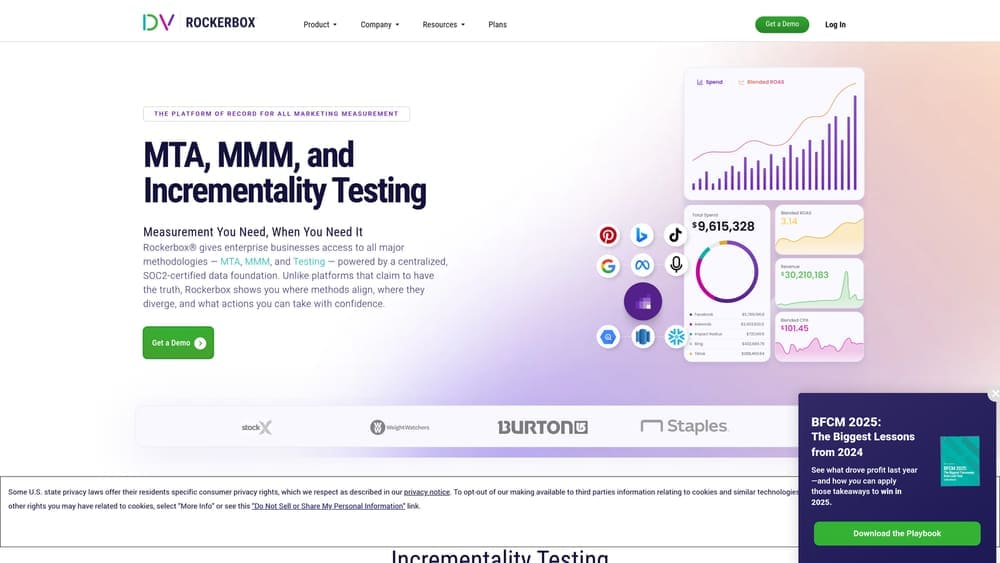
Rockerbox provides multi-touch attribution specifically designed for consumer brands navigating the complex modern marketing landscape that spans digital, retail media, and traditional channels.
Where This Tool Shines
Consumer brands face unique attribution challenges as they expand beyond traditional digital channels into retail media networks like Amazon Advertising, Walmart Connect, and Target Roundel. Rockerbox specializes in connecting these disparate channels into unified attribution models that show how upper-funnel brand building activities influence lower-funnel conversion channels.
The platform combines three measurement approaches—multi-touch attribution, marketing mix modeling, and incrementality testing—into what they call a "Marketing Measurement System of Record." This comprehensive view helps brands balance brand building with performance marketing by showing how TV ads, podcast sponsorships, and direct mail campaigns work together with digital channels to drive conversions.
Key Features & Capabilities
Multi-Touch Attribution (MTA): Tracks customer journeys across digital channels with deduplication logic that prevents overcounting when customers interact with multiple touchpoints.
Marketing Mix Modeling (MMM): Measures upper-funnel channels like TV, podcasts, and out-of-home advertising that don't generate direct clicks.
Incrementality Testing: Validates attribution model accuracy by measuring true lift from marketing activities versus baseline performance.
Retail Media Attribution: Connects advertising on Amazon, Walmart, and Target to actual sales, both on-platform and through other channels.
Marketing Data Foundation: Centralizes data from 100+ marketing and analytics platforms into a unified warehouse for comprehensive analysis.
Best For / Ideal Users
Rockerbox serves consumer brands selling through both direct-to-consumer and retail channels who need attribution across the full marketing mix. The platform is built for complexity and designed for scale, making it particularly valuable for CPG brands, consumer electronics companies, and lifestyle brands expanding into omnichannel marketing.
Brands spending $200,000+ monthly across multiple channels including retail media networks, connected TV, or traditional offline channels will benefit most. Marketing teams that need to prove ROI across diverse channel mixes—from Instagram ads to TV commercials to Amazon DSP—find the comprehensive approach essential for budget optimization.
Pricing
Custom pricing based on marketing spend and channel complexity, typically starting around $3,000/month for mid-market brands. Enterprise pricing available for large consumer brands with complex channel mixes requiring advanced features and dedicated support.
7. Northbeam
Best for: Performance marketers seeking military-grade attribution accuracy with click-level tracking and real-time optimization capabilities.
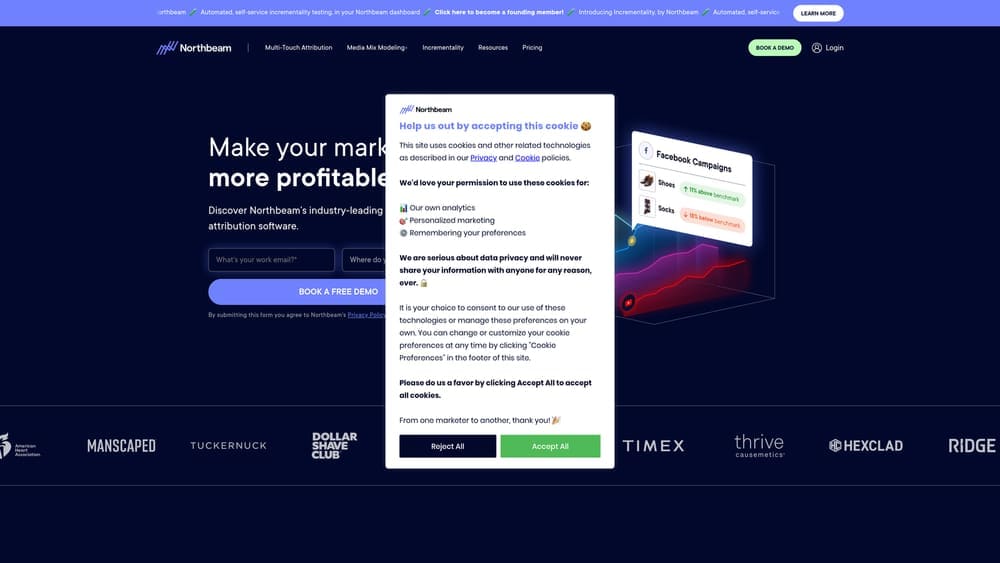
Northbeam is a marketing intelligence platform that provides multi-touch attribution and media mix modeling powered by machine learning to help businesses optimize ad spend and drive profitable growth.
Where This Tool Shines
Northbeam differentiates itself through obsessive focus on attribution accuracy using first-party data collection that bypasses browser restrictions and ad platform limitations. The platform's pixel and SDK implementation captures granular interaction data that many attribution tools miss due to iOS privacy changes and cookie deprecation.
This precision matters most for brands where small optimization improvements translate to significant revenue—when you're spending $10,000 daily on ads, knowing which creative variations and audience segments truly perform can save thousands weekly. Northbeam's real-time dashboards update throughout the day, allowing performance marketers to spot trends and adjust spending before wasting budget on underperforming campaigns.
Key Features & Capabilities
Multi-Touch Attribution (MTA): Tracks complete customer journeys across channels with industry-leading machine learning models.
Northbeam Apex: Optimizes ad algorithms using your first-party data for improved campaign performance.
Creative Analytics: Identifies best-performing ad assets across all channels to guide creative strategy.
Product Analytics: Reveals which specific products work best in advertising campaigns.
Profit Benchmarks: Focuses on profitability metrics rather than vanity metrics to increase campaign ROI.
Clicks + Deterministic Views: Attributes revenue to awareness campaigns by tracking both clicks and verified ad views.
Unified Dashboard: Consolidates all channels, campaigns, and ads in one platform with built-in correlation analysis to prove halo effects.
Best For / Ideal Users
Northbeam serves performance-focused e-commerce brands and direct-to-consumer companies that optimize ad campaigns daily based on granular data. Brands spending $100,000+ monthly on paid advertising who need precise attribution to maintain profitability will see the fastest ROI.
Marketing teams that live in dashboards and make frequent optimization decisions benefit most from the real-time data and detailed breakdowns. The platform particularly suits businesses where creative testing and audience segmentation drive competitive advantage.
Pricing
Pricing is customized based on monthly revenue and ad spend. The platform targets brands doing $1M+ annual revenue who can justify the investment through improved ad efficiency. Contact Northbeam directly for pricing tailored to your business scale.
8. Wicked Reports
Best for: Digital marketing agencies and multi-client businesses needing attribution across numerous accounts with agency-friendly reporting and white-label capabilities.
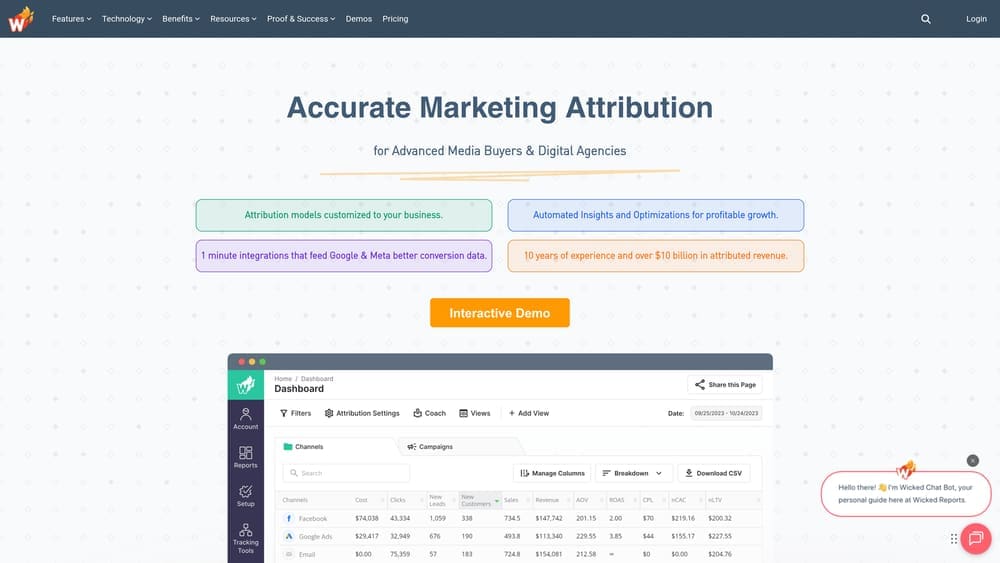
Wicked Reports provides first-party multi-touch attribution specifically designed for digital marketing agencies managing attribution across multiple client accounts simultaneously.
Where This Tool Shines
Agencies face a unique attribution nightmare that in-house teams never encounter: managing dozens of client accounts with completely different tracking setups, conversion goals, and reporting requirements while proving ROI to clients who constantly question marketing value. Wicked Reports solves this through a multi-tenant architecture that lets agencies manage all clients from a single dashboard while maintaining strict data separation between accounts.
The platform's one-click ROI reports become your secret weapon during client retention conversations. When a client questions whether Facebook ads are worth the investment, you can instantly show them which specific campaigns, ads, and even keywords drove actual revenue—not just clicks or leads. For agencies running lead generation or e-commerce campaigns across Facebook, Google, and email, Wicked Reports connects ad spend to revenue outcomes using first-party data that bypasses the accuracy problems plaguing cookie-based attribution.
Key Features & Capabilities
Multi-Client Dashboard Management: Switch between client accounts instantly without separate logins or complex navigation.
First-Party Data Tracking: Maintains attribution accuracy despite iOS privacy changes and cookie restrictions that break other tools.
Custom Attribution Models: Build attribution models tailored to each client's specific business model and sales cycle.
Automated ROI Analysis: Platform automatically calculates return on ad spend across channels without manual spreadsheet work.
White-Label Reporting: Generate client-facing reports branded with your agency logo and colors.
KPI Mapping: Connect marketing metrics to business outcomes that matter to clients beyond vanity metrics.
Best For / Ideal Users
Wicked Reports serves digital marketing agencies managing 5+ client accounts who need to prove marketing ROI consistently. It's particularly valuable for agencies specializing in Facebook and Google advertising for e-commerce or lead generation clients. Performance marketing agencies that live or die by their ability to demonstrate clear revenue attribution will find the platform justifies its cost through improved client retention alone.
Pricing
Pricing is customized based on number of client accounts and data volume. Agency plans typically start around $250-$500 per month for smaller agencies, with enterprise pricing available for larger operations managing numerous high-volume clients.
Making the Right Choice
The right attribution tool depends entirely on your business model and where you're spending marketing dollars. If you're just starting with attribution and rely heavily on Google Ads, GA4 provides sophisticated machine learning capabilities at zero cost—making it the logical first step for most businesses.
B2B companies with long sales cycles should prioritize HubSpot or similar CRM-integrated solutions that connect marketing touchpoints to actual closed revenue. E-commerce brands spending $50,000+ monthly on paid advertising will see faster ROI from specialized platforms like Attribution or Northbeam that provide daily optimization recommendations. And if phone calls drive your business, Ruler Analytics solves the offline conversion tracking gap that purely digital tools miss entirely.
The attribution landscape continues evolving as privacy regulations reshape tracking capabilities. The tools that win long-term will be those that adapt to first-party data collection while maintaining accuracy across the fragmented customer journey. Start with the platform that matches your current tracking needs and budget, but build your implementation with flexibility to evolve as your marketing sophistication grows.
Ready to optimize your marketing performance? Learn more about our services and discover how we help businesses implement data-driven marketing strategies that drive measurable results.
Campaign
Creatives
quick links
contact
© 2025 Campaign Creatives.
All rights reserved.